Showing posts with label 광고. Show all posts

I think Korean toilet ads for funny. Deal with it.

This one was easily one of the most fun to translate. At first, I thought the second line was saying "In the future, tears come gradually" but it's really more like "take a step up to the toilet and let it all out there". Again, like the secret-keeping toilet, this sign is intended to motivate those using the restroom to use it cleanly.

남자가 흘리지 말아야 할 것은 눈물만이 아니죠
한발만 앞으로 오세요. 기분까지 좋아집니다

Tears are not just the only type of water that mustn't be spilt
Step slowly up to the toilet. It will make everyone feel good

흘리다 is a doosey of a verb. Naver defines it as: cry, shed, sweat, perspire, bleed, drool, slobber, spill, drop

한발한발 gradually, step-by-step

What? toilet humor is funny, right? Anyway, try to keep the giggling down to a minimum. I just like the idea of the toilet giving me advice and, what's more, promising to protect any of my mistakes as a secret between me and Mr. Crapper.

당신의 실천이 모두를 행복하게 합니다
당신이 저를 소중히 다루시면 제가 본 것은 비빌로 하겠습니다~ 쉿 -변기올림
Your practice makes everyone happy.
"If you cherishly handle your business, anything I might see I'll keep as a secret" - From the toilet

The first part reminds me of a stitching that my mother made and posted up in one of the bathrooms. It politely stated "Be an adult not a kid / Hit the toilet not the lid".

Saw this a few months ago near 강남 at a place that served small portioned southeast asian fusion foods. I found it suprising that they would even mention this because I left hungry and wondering why I paid more than 15 000 for something that I'm pretty sure was a side dish at a normal Korean place. Anyways,


우리업소는 먹고 남기지 않을 만큼 적당한 양을 제공합니다

At our establishment, after eating, please leave an appropriate amount of leftovers.

Which, of course, is a long winded way of saying "Take all that you want but eat all you take."

"No smoking". "금연".

In English, what does that imply? Aren't there other ways to say it? "Smoking a cigarette is not allowed here", "Please do not smoke in this vicinity" or "Your disgusting cancer sticks piss Matthew the f*** off" are all acceptable ways of conveying this simple message, right? Korea is not different....except that practically every guy over the age of nine smokes.

Korean's anti-smoking campaigns (금연 운동) is certainly just cutting its teeth, but curiously child-centered ads can be seen everywhere including this one in 부산:


해운대 해수욕장 금연
(lit. Haeundae Beach No Smoking)

How cute. I either want a cigarette or a cartoon. Can't decide.


and this poorly translated clipart which made me and my coworkers laugh:

연기가 나지말라
(lit. Smoke, don't you come out)
This is clearly a cut and paste job into an automated translator but it's still really cute to ponder. It's as if the sign is telling the smoke (not cigarette smoke but smoke from a wood burning fire) to not rise. "You! Smoke! Don't you come out!"


But my personal favorite thus far is the one that I snapped in the men's room of the Catholic church in 목동. I like it because it uses 절대 which is a fun word and it's a double negative which is perfectly fine in Korean:


절대금연 - 흡연장소를 이용해주세요!!
(lit. Never No Smoking - Please use the (designated) smoking area)

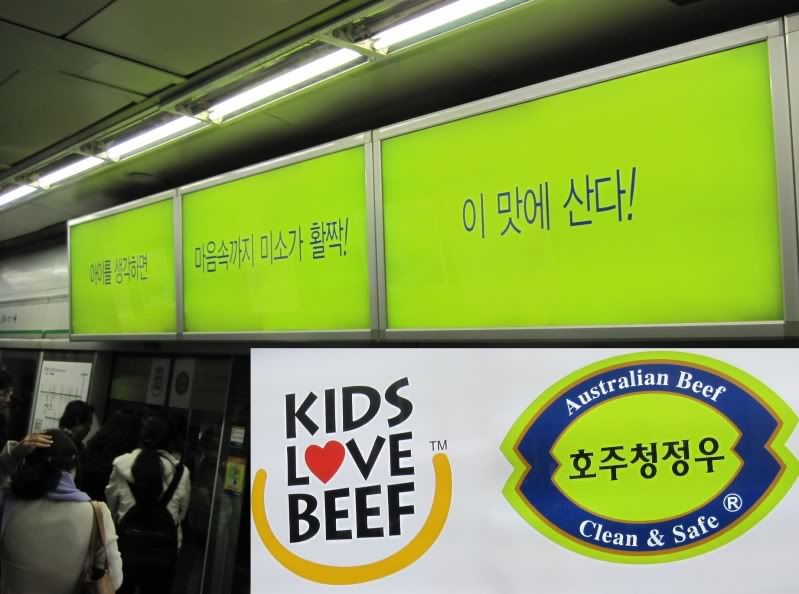
Korean Advertisements - Australian Beef


Coming in off the last wave of anti-American beef protests, this ad seems a little bit much a little too late. People are still conscious of where their food comes from as evident by the small signs posted up in most restaurants claiming that their chicken comes from Korea, their pork comes from Korea and their beef comes from Australia. Curiously, Chinese rice is usually left out in the description if applicable. Moving on. This simple subway ad puts a smile on my face which is quickly erased when I realize how much my mind was in the gutter.

Download Link

Photobucket


Text:

아이를 생각하면
When you think of your children...

마음속까지 미소가 활짝!
you can smile from the bottom of your heart!

이 맛에 산다!
(see below)

호주청정우
Australian Beef - Clean & Safe

Some fun things to note:
- "마음속" is just your plain ol' ambiguous "마음" but with 속 added. "속" means in the inside or in this expression "the bottom of your heart"
- "미소" is smile and "활짝" is wide but the English expression "you can smile widely" is just weird. A smile is already wide.
- "이 맛에 산다!" was kind of hard for me to translate actually. I mean, I know it's referring to the taste, but what exactly is "산다" in this context? It seems to mean "This taste is alive!" but that's kind of strange, right? Maybe it implies "This is what life is all about!" as in the taste of life should be full of wide smiles and no worries from evil infected American beef. Maybe it's a double meaning...

Korean Advertisements - Taxi

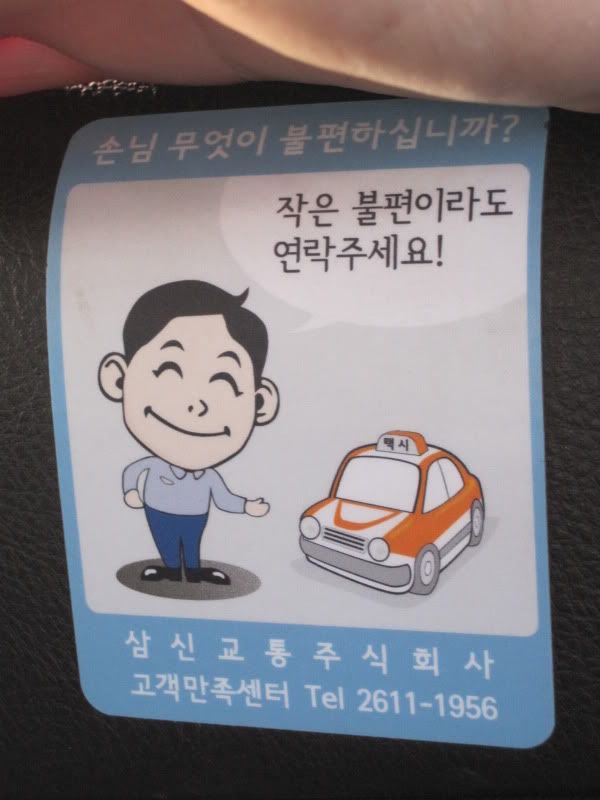
This cute-as-a-button message can be seen in most taxis in Seoul. I think it's a pretty straightforward message. I mention it here because it is one of the few ads that at first glance I understood everything about it. A milestone for sure.

Download Link

Photobucket
Text:

손님 무엇이 물편하십니까?
Customer, Is there anything uncomfortable?

작은 불편이라도 연락주세요!
Even if there is a small inconvenience let us know!

삼신교통주식회사
(company name)
고객만족센터
customer satisfaction center

Some fun things to note: 

- 고객 and 손님 both mean customer but the former is more polite. Like other titles, it's usually followed by "님" as in "고객님"
- the "불" in "불편하다" is a great little Hanja that negates any verb. in this case, "편하다" - to be comfortable. "불편하다" - to be uncomfortable. another common example would be "가능하다" to be possible and "불가능하다" to be impossible, a great way to tell your boss that, no, you can't prepare all that he or she asked for in less than 5 minutes before the meeting. it's a polite and indirect way of saying "nuhh-uh"

Korean Advertisements - English School (여어 학원)

Perhaps a new feature to the blog might be the inclusion of some interesting advertisements. I'm not really interested in collecting Engrish or the sort; this will be more of some culturally or linguistically curious decisions that the ad people have made. I've taken a few photos and I'll host them to give you a better idea of what I'm talking about. However, I'll blur a few identifying features just for safety's sake....as if copyright even exists in Korea.

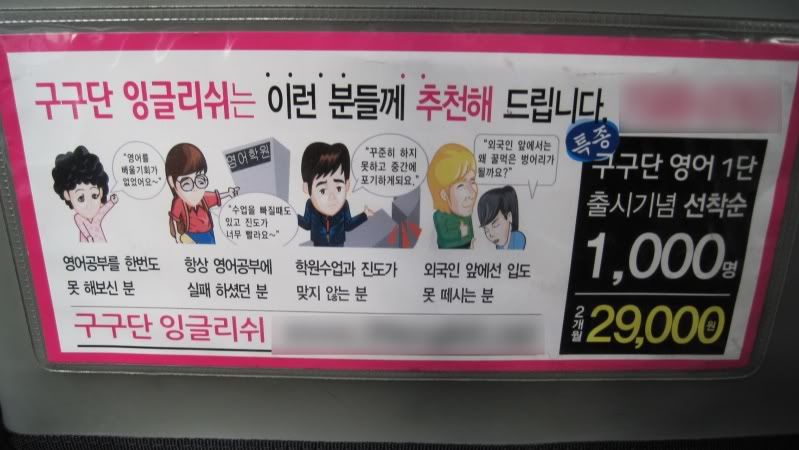
The first one I'd like to talk about is an ad I see on the back of the chairs on almost every bus I take. It's an ad for an English 학원 and it is really something. If you've ridden a bus in Seoul within the last year or so, you've seen it. The art is just classic for this type of ad. I love the depiction of the blond guy getting some form of respectful deferment from the bashful Korean woman. Plus, some of the literal translations really make me laugh. I stare at this almost every morning. It's an effective ad, sure, but good lord is it creepy.

Download link

Photobucket

Text:
구구단 잉글리쉬는 이런 분들께 추천해 드립니다.
99English is recommended for these types of people.

"영어를 배울기회가 없었어요~"
"I've never had a chance to learn English~"
영어공부를 한번도 못 해보신 분
People who have never studied English before.

"수업을 빠질때도 있고 진도가 너무 빨라요"
I missed class and the pace of the class was too fast"
항상 영어고부에 실패 하셨던 분
People who always fail at English

"꾸준히 하지 못하고 중간에 포기하게되요"
"I constantly try but I always give up halfway"
학원 수업과 진도가 맞지 않는 분
People who thought previous classes and paces did not fit their style

"외국인 앞에서는 왜 꿀먹은 벙어리가 될까요?"
"Why do I choke up in front of foreigners?"
외국인 앞에선 입도 못 떼시는 분
People whose lips don't move in front of foreigners

2개월 29,000원
Two months for 29,000 Won
출시기념 선착준 1,000명
This introductory offer is only available to the first one thousand people


Some fun things to note:
- while 구구단 is the name of the 학원, it's also the name of the multiplication tables in Korean. I believe the name is derived from old math charts that went up to 9 thus making a 9 x 9 grid or a 九九段= 구(nine)구(nine)단(division, block). I assume that means that the school operates in a structured environment and goes by the rules of grammar.
- "잉글리쉬" is just a butchering of the word "English". ever wonder why some Koreans can say the word "English"? I blame it on stuff like this. If one wants to say "English" in the English language, you need to properly read and write English. Otherwise, just say it in Korean. There's nothing wrong with saying "영어" when referring to English. I have the same gripe in English, too. "Ahnnyeonghaseyo" should not be used for "안녕하세요". Simple say "Hello" if speaking English. Rant over.
- "특종" means "exclusive" or "scoop" or in this case, can be understood as "special deal"
- "분", "사람" and "인" are all ways of expressing "person". 분 is the most polite, as in "남편은 한국분이세요?" (Is your husband Korean?)
- "추천하다" is to recommend. One can see "추천" in bold letters on many menus.
- "배울기회" is two words in one. "배우다" to learn and "기회" opportunity. The implication is "the chance to learn" or "the opportunity to learn"
- "한번도" means "not even once". Careful not to mispronounce this into the word for the Korean peninsula "한반도"
- "꾸준히" is "constant" or "consistent"
- "중간" is "the middle" and "포기하다" is to "give up", "abandon" or "renounce". The implication is "to give up in the middle" or "quit when you plateau off"
- "꿀 먹은 벙어리" means to be deaf but the feeling is to "choke up" from either shyness or lack of confidence
- "출시기념" is two words in one. "출시" is "release" or "debut" and "기념" is "memorial" or "commemoration" as in "결혼기념" (wedding anniversary) or "전쟁기념관" (Korean War memorial hall)